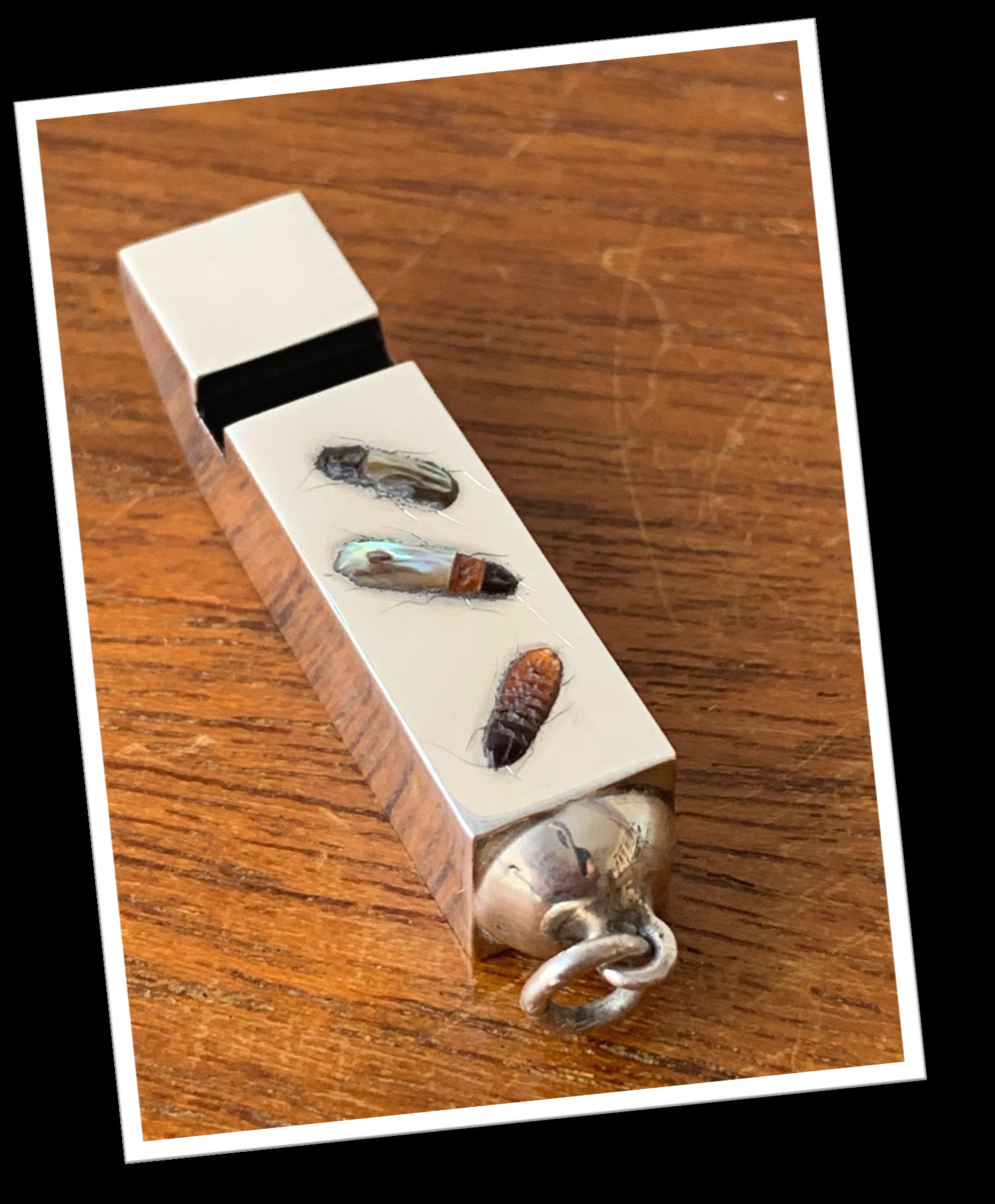
Whistles
The whistle is one of the oldest signalling instruments crafted by human hands. From the nineteenth century onward, its production became increasingly specialised and refined: naval whistles for commanding manoeuvres aboard ship, hunting whistles for guiding dogs or rallying field parties, referee whistles that emerged with the rise of team sports towards the end of the century, and decorative or novelty whistles, sometimes mounted as charms or presented as society gifts. England established itself as a major centre of production, most notably with the house of Joseph Hudson & Co., founded in Birmingham in 1870, whose models went on to equip police forces and referees the world over. France, Germany, and Switzerland also produced pieces of considerable quality, often more ornately fashioned.
Materials vary according to the intended use and the standing of the object: nickel-plated or silver-plated brass dominates standard production, while sterling silver, bone, ivory, or tortoiseshell characterise prestige examples. Certain models combine several materials, with metal bodies and mouthpieces of horn or ebony. The forms can be surprising: cylindrical or ovoid whistles, bird-shaped models, or instruments integrated into other objects such as walking canes or key fobs.
For the collector, several criteria merit close attention. Hallmarks — silver standard marks, maker's marks, or manufacturer's stamps — are essential reference points for dating and localising a piece. The condition of the internal mechanism, in particular the reed or the windway edge, determines the instrument's acoustic function, which remains a criterion of authenticity in its own right. One should also verify the absence of non-original soldering, repainting, or clumsy repairs liable to diminish the value of the object.